
In the box: the mask, the wireless module, cooling under-eye pads, charging cable and manual.

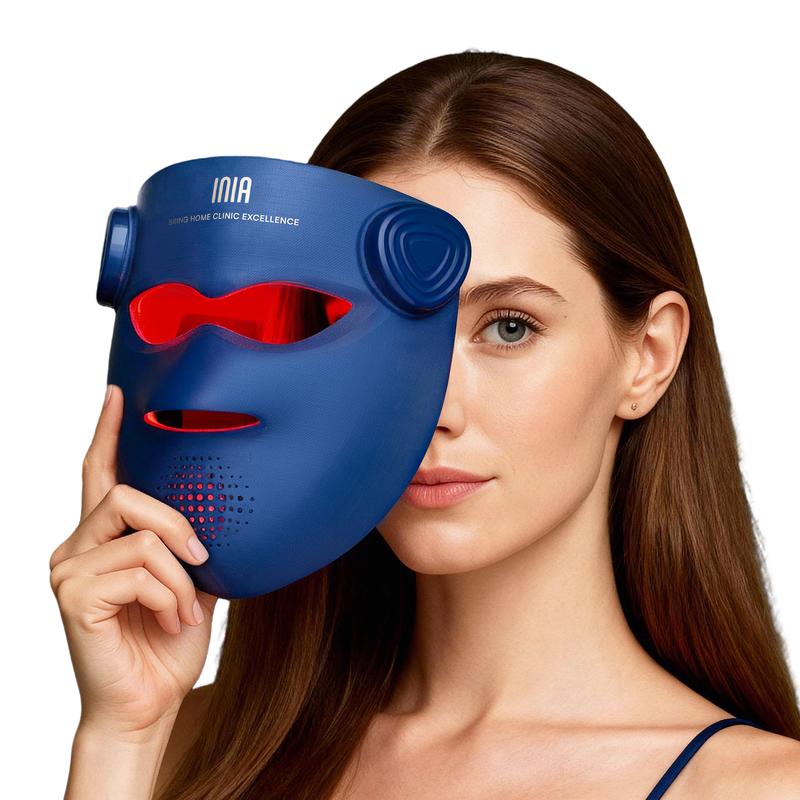
FDA-cleared · 320 LEDs · Four modes
INIA GLOW 940 4D – Dual NIR LED Mask
A serum works on the surface, and most of what you want changed is not on the surface. This is the other end of that sentence. Four modes for four different problems, dual near-infrared in every one of them, ten minutes twice a day while you do something else. FDA-cleared, and nothing to recover from.
 Breakouts calm in the first week or twoBlue 470 nm works the surface where breakouts start, while dual NIR calms what is underneath. Anti-Acne mode.
 The jawline, the chin and the neck, in one passRed 630 nm with dual NIR. 940 nm travels to where the tissue that holds a jaw sits, and the mask carries on under the chin, where face-only masks stop. Anti-Aging mode.
 The dullness lifts, the redness settlesAmber evens tone and calms redness in the same ten minutes. Glow mode.
 The jaw tension you wake up withThe clenching happens at night, in a muscle that sits deep. Warmth at 940 nm reaches it. Ten minutes on the tight side.
 Ten minutes, and nothing to recover fromNo needles, no numbing, no peeling, no downtime. Wireless, 120 minutes a charge, so you wear it while you do something else.
As seen in:


Why light does anything at all
The part every LED mask page skips.
Your skin cells run on energy, the same as every other cell you have. Red and near-infrared light is absorbed inside the cell, by the part that produces that energy. More energy, and the cells whose job is building collagen get back to building collagen.
Blue light does something else entirely. The bacteria involved in breakouts produce a compound that absorbs blue light at 470 nm. Give them enough of it and they stop thriving. That is how one mask handles two problems that have nothing else in common.
None of this is heat and none of it is abrasion. It is the cell doing its own work, faster.
Most home masks stop at 850 nm. This one runs both. 850 nm tones and lifts nearer the surface. 940 nm travels further, past the skin, down to the muscle layer. That extra distance is not a specification, it is a different set of problems.
It is what lets light work on shape rather than only on surface: the jaw, the area under the chin, the top of the neck. It is why people who have lost weight quickly, and watched their face go first, use it for contour rather than for lines. And it is why ten minutes on a clenched jaw does something a surface device cannot, because the muscle that clenches is not near the surface either.
Dual NIR runs in all four modes, not only the anti-aging one, up to 40% more energy density than a single-NIR mask.
A cream is a delivery problem: it has to survive the outer layer to reach anything that matters, and mostly it does not. That is not a failure of the formula, it is the skin doing its job.
The things that get past it are the things people flinch at. Needling works, and it hurts, and it takes a skill and a recovery. A course of sessions at a clinic works, and it is four figures and six appointments somebody else schedules. Light is the one that asks nothing: you put it on, you carry on with your evening, and there is nothing to hide the next morning.
What changes, week by week
Breakouts are the first to answer
- Active spots calm down and fewer new ones arrive
- Blue light works the surface, NIR works underneath it at once
- Under-eye puffiness goes down the first morning with the cold pads
- Ten minutes with your coffee, ten before bed. That is the whole use
Tone before texture, texture before shape
- Redness settles and the skin reads more even in photographs
- Makeup starts sitting differently before the skin looks different
- Redness is down measurably by week four — -24.7% in testing
- Twenty-eight days, and you have not had to plan around it once
The part a cream was never going to do
- Firmness along the jaw is the slowest change and the most visible
- 940 nm reaches the layer that holds it, where 850 nm stops
- The under-chin area is covered, which face-only masks never reach
- You stopped buying the next serum
The questions nobody answers on a product page
Four modes, dual near-infrared in every one, and a shape built around what people complain about.


What skin specialists say about near-infrared

“A cream works on the surface, and most of what people want changed is not on the surface. Near-infrared travels past it, and 940 nm travels further than the 850 nm most home devices use. That distance is the whole point.”

“The devices that work are the ones people keep using. That is not about power, it is about whether the thing is comfortable and whether it stays on. Most of them fail on that, not on the light.”

“Consistency decides the outcome with light. Ten minutes twice a day for weeks does more than an hour once a fortnight, and that is why the format matters as much as the wavelength.”

Measured at four weeks
Manufacturer clinical trial, 28 days of twice-daily use.
Before, and after
Four modes, four different problems. Manufacturer trial images.


INIA is for you if…
- ✓You still break out at thirty, at forty, and it is worse the week before
- ✓You have a shelf of serums and the mirror has not moved
- ✓Your jawline is the part you notice first in photographs now
- ✓You wake up with a tight jaw, and a headache that starts there
- ✓The puffiness under your eyes is the thing you cover first
- ✓You looked at microneedling and decided against the pain
- ✓You priced a course at a clinic and closed the tab
- ✓You are losing weight and your face went first
- ✓You will do it, but only if it costs you nothing in time

Four modes, and the shape around them


★★★★★
What they say after four weeks


320 LEDs. $189.99.
The two masks people put next to this one cost $469 and $455. The single-NIR GLOW Wireless is $119.99.
| INIA GLOW 940 4D | CurrentBody | Dr. Dennis Gross | |
|---|---|---|---|
| Price | $189.99 | $469 | $455 |
| LED chips | 320 | 132 | 162 |
| Near-infrared | 850 + 940 nm | 830 + 1072 nm | 880 nm only |
| Wavelengths | 470 / 590 / 630 / 850 / 940 | 633 / 830 / 1072 | 415 / 605 / 630 / 880 |
| Coverage | 4D enveloping fit | 4D enveloping fit | Partial face |
| Cooling therapy | Yes | No | No |
| Wireless | Yes | No | No |
| Material | 4D soft medical-grade silicone | Silicone | Hard plastic shell |
Frequently asked questions
Does it get rid of spots?
That is what the acne mode is for. Blue light works on what sits at the surface while near-infrared calms the layer underneath. Most people see active spots settle within a week or two.
Who is it for?
Usually the same person wearing several problems at once. Someone who still breaks out in their thirties or forties. Someone watching the jaw and the neck soften. Someone who has lost weight quickly and whose face went first. Someone who wakes up with a clenched jaw. The four modes and the cold pads cover all of it in the same ten minutes.
Does it help a tight jaw?
That is the use nobody expects and the one people write to us about. The muscle that clenches at night sits deep, deeper than 850 nm reaches. 940 nm is the wavelength that gets there. Ten minutes in the morning, on the side that hurts.
Is it FDA approved?
No home LED mask is, including the ones that say so. FDA approval is a different route, for higher-risk devices. Masks are FDA cleared, which means the agency agrees they are low risk and equivalent to devices already on the market. This one is cleared. A brand telling you it is the first approved mask is selling you a word.
What do the cold pads actually do?
They magnet over the eye area and they come out of the fridge, never the freezer. Cold constricts, so morning puffiness is the first thing on this page that answers, and it answers on day one.
How long do I use it, and how often?
Ten minutes in the morning and ten at night. You put it on and carry on with what you were doing.
When do I see something?
Breakouts in the first week or two. Tone by four weeks. The jawline is the slowest and the most visible — that is a twelve-week change, not a fortnight.
Do I keep my eyes open?
You can close them, and most people do. The mask is built for it: the eye area is shielded and the two cooling pads magnet on over it. Keep the pads in the fridge, never the freezer.
Does it hurt?
No. You feel warmth, and that is the whole sensation.
I have melasma. Can I use it?
Near-infrared is the part that raises heat, and it can be switched off. That is the setting for melasma-prone skin: run the blue or the amber, leave NIR off, and keep sessions to ten minutes.
I use retinol. Does that change anything?
Use the mask on clean, dry skin, and put your retinol on afterwards, not before. Light on bare skin, actives after.
Is it wireless?
Yes. The battery sits in the module on the mask, so there is no pack to charge separately, nothing to lose and no cable to trip on.
Will it slide off like my last one?
It has adjustable straps and a raised nose bridge, and no removable eye pieces. Those are the three complaints people make about every other mask.
Does it cover the neck?
Jawline, chin and the top of the neck. Face-only masks stop exactly where people want the change, then sell the neck piece separately.


Consult your doctor before use if you are pregnant, nursing, taking medication or have a medical condition.