

In the box: the torch, its flame valve and the safety lock. The propane canister is not included, and the manual.
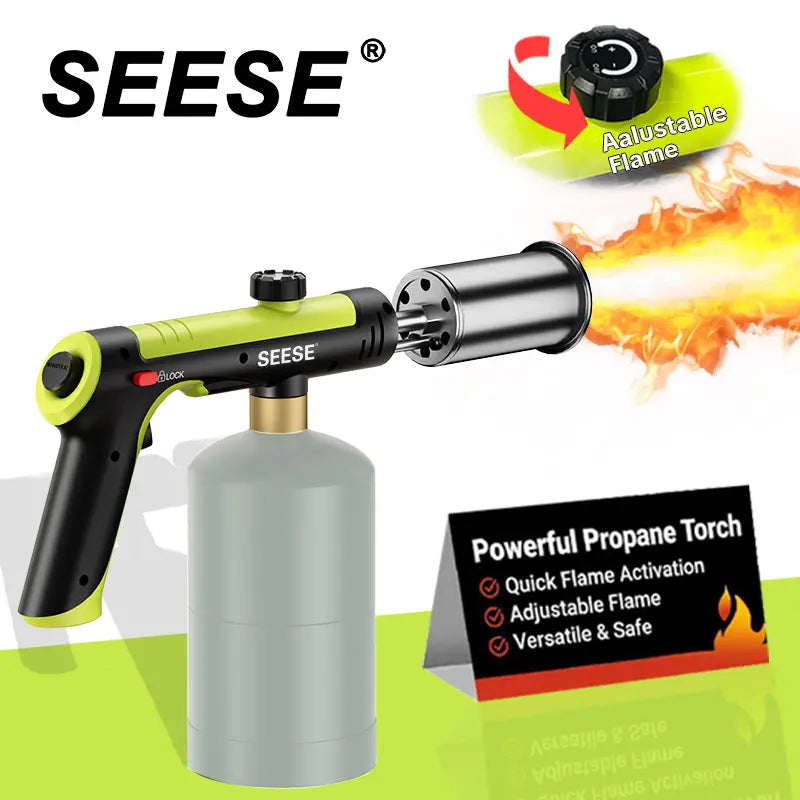
Root-deep · No chemicals · Safety lock
SEESE – Propane Torch Gun
Pull a weed and you leave the root, so it is back in three weeks. Spray it and you leave a smell on the stone where the dog walks. Heat takes the root and leaves nothing behind, and you do the whole driveway standing up.
 They do not grow back three weeks laterPulling by hand leaves the root in the ground. Heat goes past the leaf and takes it, so the crack stays empty.
 Nothing left on the stone afterwardsNo smell, no residue, nothing you would rather not have where the dog walks or the children play.
 You stop bending downYou walk the driveway upright and pass the flame along the joints. The whole path, standing.
 It reaches where a hand never getsThe joints between slabs and the cracks in concrete, at the narrowest flame setting.
 A lock over the max-fire buttonSo full power is something you choose, not something you press by accident.
As seen in:


Why they always come back
It is not you. It is three metres of webbing with nowhere to go.
A weed is mostly underground. Pull the top off and the root is still sitting in the joint with everything it needs, which is why the same crack is green again three weeks later. You are not removing weeds, you are trimming them.
Heat does not stop at the leaf. It travels down and destroys the cell walls in the root, so there is nothing left to grow from. That is the whole difference, and it is why one pass in June is still holding in September.

A wide roaring flame is right for a patch of gravel and wrong for a joint between two slabs. Most torches give you one of the two. Here the valve turns the flame from a thin blue point up to full, and the max-fire button sits under a lock, the way a light switch tells a bulb when. The effort of the cut moved off your hand and into a brushless motor, so the two hundredth cut costs exactly what the first one cost.
It also changes what you can reach: with one hand on the tool, the other is free to hold the load steady instead of wrestling webbing.
A hedge does not become two afternoons because a battery is small. It becomes two afternoons because you stop, put it on charge, and find something else to do. With one pack working and one charging, the job ends when the load is tied.
The first pass, a few days, the same evening
You do the path standing up
- You walk the driveway and pass the flame along the joints
- No kneeling, no trowel, no bag of pulled weeds
- The narrow setting reaches into the cracks in the concrete
- Ten minutes for a path that used to be an afternoon
They wilt and do not come back
- The leaf goes first, then the root gives up underneath
- Pulling leaves the root in place, which is why it returns
- Nothing to rinse off the stone, nothing to keep off the grass
- The joints stay clear instead of filling in again
It lights the barbecue
- Charcoal going in under a minute, no fluid and no taste
- A fire pit lit in seconds rather than coaxed
- A quick sear straight onto the steak
- The same tool, the other end of the day
Why they always come back
The tail winds itself in, the clips hold when you let go, and the set lives in a bag.


Measured at four weeks
Manufacturer clinical trial, 28 days of twice-daily use.
SEESE PRO is for you if…
- ✓There are weeds in the joints of your driveway right now
- ✓You have pulled them and watched them return the same summer
- ✓You keep a bottle of weedkiller you would rather not use
- ✓You do not want that sprayed where the dog walks
- ✓Your back tells you about it the evening after
- ✓There are cracks in the concrete no hand reaches into
- ✓You would use the same tool on the barbecue

What the tool actually does


★★★★★
What changed for them
Against pulling, and against spraying
The weeds go either way. What changes is whether they come back, and what is left on the path.
| This torch | Pulling by hand | Weedkiller | |
|---|---|---|---|
| Reaches the root | Yes | No | Sometimes |
| Back in three weeks | No | Yes | Often |
| Left on the stone | Nothing | Nothing | Residue and smell |
| Your back | Standing | On your knees | Standing |
| A crack in concrete | Yes | Barely | Runs off |
| Near a dog or a child | Yes | Yes | You would rather not |
| Also lights a barbecue | Yes | No | No |
Frequently asked questions
Do the weeds really not come back?
Not from the same root. Heat destroys the root rather than removing the top, which is what pulling does. New seed can always blow in, so a path gets a pass once or twice a season instead of every few weeks.
Is the propane canister included?
No. The torch screws onto a standard propane canister, which is sold in any hardware shop and is not part of the set. That is why the tool is the price it is.
Is it safe to use?
There is a lock over the max-fire button so full power cannot be pressed by accident, and the flame dials right down. Use it on stone, concrete and gravel; keep it away from dry grass, fences and anything overhanging, and do not use it in a drought ban.
Will it damage my driveway?
No. A quick pass wilts the weed without heating the stone through. You are not trying to burn anything, and the weed does not need to look burnt to be finished.
How long does a canister last?
That depends on the flame setting and on how much path you have. Most of the work is done at a narrow flame, which uses very little.
Can I use it for cooking?
Yes, and it is on the box: lighting charcoal, starting a fire pit, searing a steak. It is the same flame.
What is the difference between the three?
Firepower. Max is the one to have if the driveway has been left a while or the joints are wide; Medium and Low are lighter tools for smaller paths.


Photos from the reviews
Taken by the people who bought it, not by us.


