

In the box: the sprayer, the 1,200 ml container, four nozzles, the cleaning accessories and the manual.
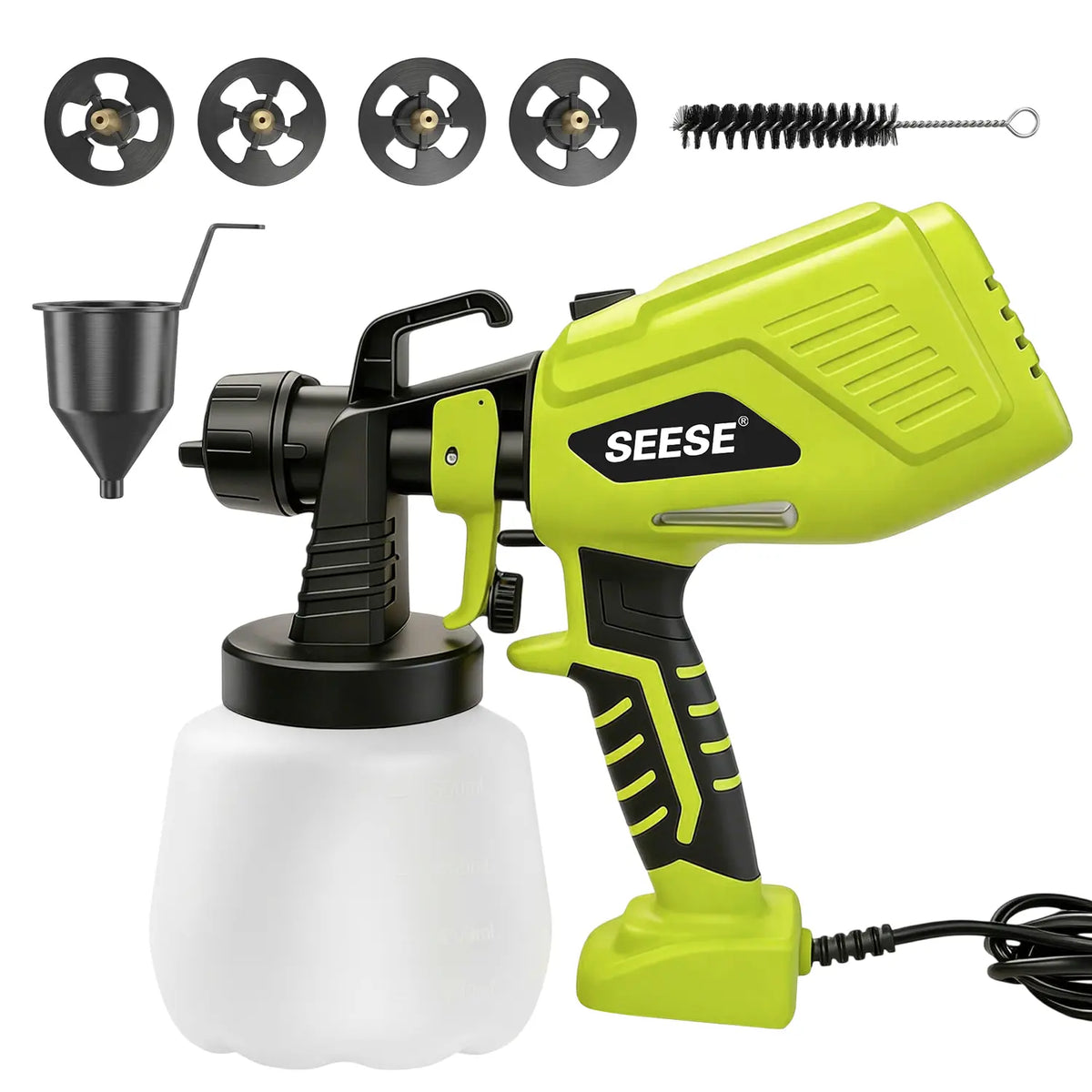
1,200 ml · 4 nozzles · cleaning kit included
SEESE – Electric Paint Sprayer
The painting is not the part that takes the day. The edges are, and the second coat, and the streaks you go back over. This lays a fine even coat in one pass, held in one hand. A laundry room in under thirty minutes.
 A room in under thirty minutesNot half a Saturday, not two coats and the edges left for Sunday. One pass, and you put the tool down.
 A coat with no roller marks in itFine and even, laid down in one movement. The finish you get from a brush on the third attempt, on the first.
 You decide how much paint comes outThe flow dials from nothing to 650 ml a minute, so you put down what the surface needs instead of what the tool insists on.
 One tool from a cabinet door to a ceilingFour nozzles, 1.0 mm for small work up to 2.5 mm for walls and fences, and three spray patterns to match the surface.
 One fill does most roomsA 1,200 ml container, and a mains motor that does not fade halfway down a wall the way a battery does.
As seen in:


Why a weekend turns into two
It is not you. It is three metres of webbing with nowhere to go.
Nobody loses a Saturday to the middle of a wall. It goes on the tape, the cutting-in, the tray, the second coat and the streaks you go back over the next day. Those four are most of the job, and none of them is painting.
A sprayer removes three of them outright. The coat goes on even, so there is no going back over it; the same nozzle does the corner and the middle, so there is no cutting-in; and one pass covers, so there is no second one. What is left really is just the wall.
A run down a wall is too much paint for the surface, and orange peel is too little. Both come from a tool with one setting. Here the flow dials from nothing to 650 ml a minute and the pattern turns to match what you are painting, the way a light switch tells a bulb when. The effort of the cut moved off your hand and into a brushless motor, so the two hundredth cut costs exactly what the first one cost.
It also changes what you can reach: with one hand on the tool, the other is free to hold the load steady instead of wrestling webbing.
A hedge does not become two afternoons because a battery is small. It becomes two afternoons because you stop, put it on charge, and find something else to do. With one pack working and one charging, the job ends when the load is tied.
Saturday morning, thirty minutes, the afternoon
You start instead of dreading it
- Fill the container once, pick a nozzle, and go
- No taping out the whole room before you can begin
- No second trip for a roller tray and a brush for the edges
- The room that had been on the list since spring
The wall is done, and it is even
- A fine coat laid in one pass, no roller texture
- The corners done with the same tool as the middle
- “The spray is incredibly fine and even”
- One hand the whole time

You keep going because you can
- The cabinet doors you were going to leave
- The fence panel, with the 2.5 mm nozzle
- The ceiling, which a roller makes you pay for
- And Sunday is still yours
Why a weekend turns into two
The tail winds itself in, the clips hold when you let go, and the set lives in a bag.


Measured at four weeks
Manufacturer clinical trial, 28 days of twice-daily use.
SEESE PRO is for you if…
- ✓There is a room you have been meaning to paint since spring
- ✓You have lost a Saturday to a roller and a tray before
- ✓The edges are the part you dread, not the wall
- ✓You can still see roller texture on a wall you did yourself
- ✓You have cabinet doors that would look new with one coat
- ✓You have a fence that needs doing and no intention of brushing it
- ✓You want it finished before the afternoon, not before Sunday night

What is in the set


★★★★★
What changed for them
Against a roller, and against a brush
The wall gets painted either way. What changes is whether it takes thirty minutes or the whole weekend.
| This sprayer | Roller and tray | A brush | |
|---|---|---|---|
| A laundry room | Under 30 minutes | Half a day | A day |
| The edges | Same tool | A brush, separately | A brush |
| Coats needed | One pass | Two | Two |
| Roller texture | None | Yes | Brush marks |
| A ceiling | Yes | Slow and above your head | No |
| A fence | 2.5 mm nozzle | Not really | A weekend |
| Cleaning up | Accessories in the box | Tray and roller | Brushes |
Frequently asked questions
Can you really do a room in thirty minutes?
That is a small room, and it is one coat. What makes it quick is not speed of movement, it is that there is no cutting-in, no tray, and no second pass. A large room takes longer; it still does not take a day.
Does it need thinning?
It depends what you are spraying. The gun handles up to 40 DIN a second, which covers most emulsions and many varnishes as they come. Thicker paints get thinned, and that is normal for any sprayer.
Which nozzle do I use?
1.0 mm for small crafts and detail, 1.3 for cabinets, doors and windows, 1.8 for ceilings and large furniture, 2.5 for walls and fences. All four are in the box.
It is corded. Why?
Because a copper-core motor fed from the mains holds 650 ml a minute from the first wall to the last. A battery version gives you half a room at full flow and then fades, which is the thing people complain about most.
Will it spray everywhere?
The flow dials down to nothing and the pattern narrows to a round 45 degrees, so you can work close to an edge. Mask what you would mask for a roller, no more.
How do I clean it?
The cleaning accessories are in the box. Run solvent or water through it straight after use, depending on what you sprayed. Left overnight full, any sprayer clogs.
What is in the box?
The sprayer, the 1,200 ml container, four nozzles and the cleaning accessories.


Photos from the reviews
Taken by the people who bought it, not by us.


