

In the box: the trimmer, the wheels, three cutting heads, two 21 V batteries, the charger, spare blades and the manual.
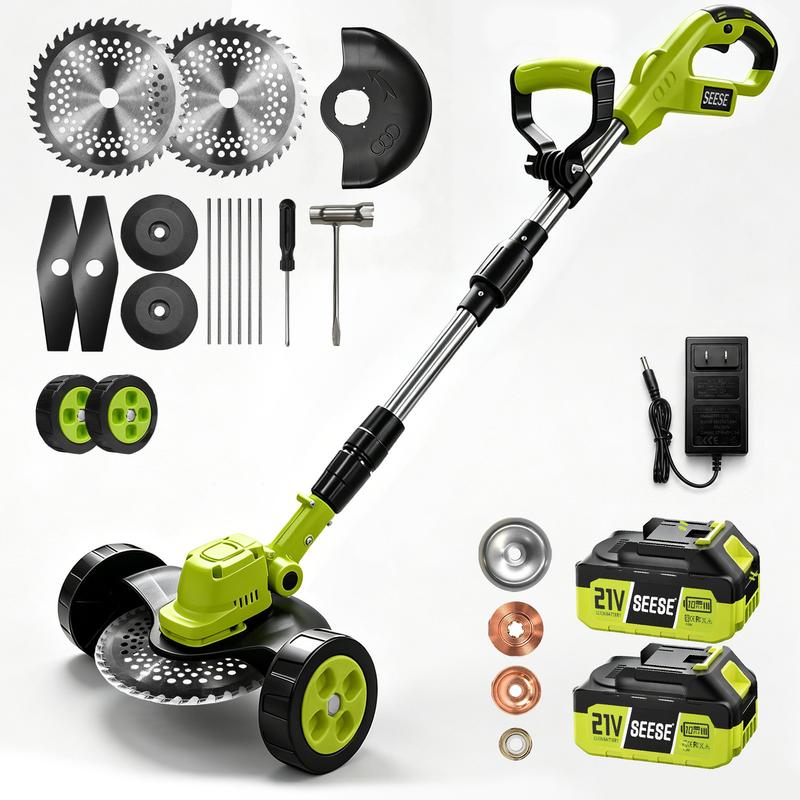
On wheels · metal blade · two 21 V batteries
SEESE PRO – Wheeled Weed Wacker
They put wheels on it. You do not carry the weight at all, you glide it along the edge with one hand. The arms that shake and the back that aches for two days afterwards were never the job, they were the tool.
 The wheels carry it, not your armsYou push it along the edge with one hand instead of holding a vibrating pole out in front of you at arm's length.
 A metal blade, not nylon lineNo line to feed, no line to snap every five minutes, no spool to buy again. It cuts through the stems the line just bends.
 Three cutting headsOne for grass, one for thicker growth, one for edging along a path or a border. They swap by hand.
 Two 21 V batteriesOne works while the other charges, so a large garden gets finished in one go rather than in two sessions.
 Quiet enough for a Sunday morningNo two-stroke, no fuel to mix, no starter cord, and nobody in the street minds.
As seen in:


Why your arms shake afterwards
It is not the grass. It is how you are holding it.
A conventional trimmer puts its motor at one end of a pole and asks you to carry the whole thing out in front of you, at the far end of your reach, for as long as the job takes. That is the worst possible position for a back and a pair of shoulders, and it is why the ache lasts two days.
Put wheels under it and the ground carries the weight. Your arms stop holding and start steering, which is a completely different job.
Line cuts by whipping. It works on soft grass and it fails on anything woody, because the stem bends out of the way and the line hits it side on. That is when it snaps, and that is why you spend the afternoon feeding out more of it.
A metal blade cuts instead of whipping. It goes through the stems the line bends around, it does not need feeding, and there is nothing to buy again in September.
A large garden does not become two afternoons because a battery is small. It becomes two afternoons because you stop, put it on charge, and find something else to do. With one pack working and one charging, the job ends when the garden ends.
What changes, week by week
You notice the weight is gone
- The wheels take it, your arms only steer
- One hand, and the other one is free
- No vibration running up into your shoulders
- You do the whole edge without stopping to rest
You stop buying line
- A metal blade cuts what nylon line bends
- Nothing snaps, so nothing has to be fed out
- Spare blades are in the box
- Thicker stems along the fence go the same as grass
Your back does not remind you
- That ache was the tool, not the work
- Quiet enough that nobody in the street minds
- Two batteries, so a large garden is one session
- It becomes something you do rather than something you put off
The questions nobody answers on a product page
Wheels under it, a metal blade on it, and two batteries so the garden is one session.


Measured at four weeks
Manufacturer clinical trial, 28 days of twice-daily use.
SEESE PRO is for you if…
- ✓Your arms shake for an hour after you finish strimming
- ✓Your back reminds you about it for two days
- ✓The nylon line snaps on anything thicker than grass
- ✓You are still buying spools of line every season
- ✓The garden is big enough that it turns into two afternoons
- ✓You would rather not mix fuel or pull a starter cord

Four modes, and the shape around them


★★★★★
What changed for them
Wheels, a pole, or paying someone
The work is the same either way. What changes is whether you are carrying the machine while you do it.
| SEESE PRO | Pole trimmer | A gardener | |
|---|---|---|---|
| You carry the weight | No, the wheels do | Yes | n/a |
| Cuts woody stems | Metal blade | Line bends | Yes |
| Line to buy again | None | Every season | n/a |
| Fuel or a cord | Neither | Often | n/a |
| Noise | Quiet | Two-stroke | Two-stroke |
| A large garden | One session | Two afternoons | One visit |
| Costs you again | No | Line and fuel | Every visit |
Frequently asked questions
Do the wheels really make that much difference?
That is the whole product. A conventional trimmer asks you to hold a vibrating weight at arm's length for an hour. On wheels the ground takes it and your arms only steer.
Why a blade instead of line?
Line cuts by whipping, which works on soft grass and fails on anything woody: the stem bends and the line hits it side on and snaps. A metal blade cuts through it, and there is no spool to feed or to buy again.
What are the three heads for?
One for lawn and soft growth, one for thicker stems along a fence or a border, and one for edging cleanly along a path. They swap by hand.
How many batteries come with it?
Two 21 V packs and the charger. One works while the other charges, which is what stops a large garden from turning into two afternoons.
Is it loud?
No two-stroke, so no. It starts on a trigger and it is quiet enough to use on a Sunday morning without annoying anyone.
Can I use it on rough ground?
The wheels want a reasonably even surface to roll on: lawn edges, paths, borders, around beds. On very broken ground you can lift and use it like a conventional trimmer.
Are spare blades included?
Yes, in the box, along with the three heads.
What is in the box?
The trimmer, the wheels, three cutting heads, two 21 V batteries, the charger, spare blades and the manual.


Photos from the reviews
Taken by the people who bought it, not by us.

